Pearls are organic gems from mollusks. Value depends on natural vs cultured origin, type, luster, size, shape and surface — with luster the heart of a pearl's beauty.
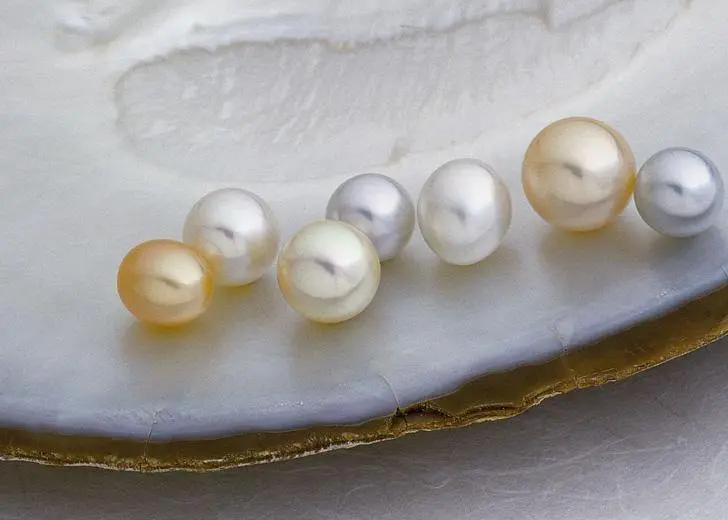
Pearls are valued by type and origin first; natural pearls are extremely rare, while cultured pearls dominate the market.

The largest cultured pearls (white or golden), from Australia, Indonesia and the Philippines. Big, lustrous and the most valuable cultured type.
Naturally dark pearls with green, peacock and aubergine overtones, from French Polynesia.
Akoya (Japan) gives the classic round white strand; freshwater pearls are abundant and affordable.
Six main criteria determine the price per carat. It is their combination that sets the final value.
Body color and overtone affect value: fine golden South Sea and peacock Tahitian command premiums; even, attractive color is key.
Natural pearls (no nucleus, very rare) far outvalue cultured. Among cultured: South Sea, Tahitian, Akoya, then freshwater.
Look out for dyeing, irradiation and heavy polishing; untreated natural-color pearls are most valuable.
Surface quality matters: fewer blemishes mean higher value. A clean, smooth surface is prized.
Pearls are sized by millimeter, not carat; larger pearls of equal quality are far rarer and pricier.
For natural or high-value pearls, a lab report (e.g. SSEF, GIA) confirming natural vs cultured is essential.

Luster — the sharp, mirror-like glow from deep within — is the single most important value factor.
Round shape, large size, clean surface and attractive color then refine the price.
Natural pearls form without human help and are extraordinarily rare today, commanding very high prices at auction.
Almost all pearls sold now are cultured; among them, South Sea and Tahitian lead on value.
Geographic origin can be a strong prestige marker that weighs on value.
Finest white South Sea pearls.
High priceTahitian black pearls.
Mid-high priceClassic Akoya cultured pearls.
Mid priceGolden South Sea pearls.
Mid-high priceWhite and golden South Sea pearls.
Mid priceVast majority of freshwater pearls.
AccessibleIllustrative price index (2010 = 100) for fine, certified stones.
Natural pearls and fine large South Sea strands have appreciated; commercial freshwater pearls are inexpensive.
Luster, size and certification of natural origin drive the high end.
Illustrative figures for fine, certified stones — not financial advice.
Orders of magnitude per pearl — fine large South Sea pearls and natural pearls far exceed these figures.
Indicative estimates — they do not replace a laboratory appraisal.
Enter color, weight, treatment and origin: our estimator computes an instant price range, then generates a detailed report.
💎 Start free valuation →